

1. Inspection Conditions
Inspection performed under the following conditions is recommended:
- Temperature: 25±5℃
- Humidity: 65%±10%RH
- Viewing Angle: Normal viewing angle.
- Illumination: Single fluorescent lamp (300 to 700Lux)
- Viewing distance: 30-50cm
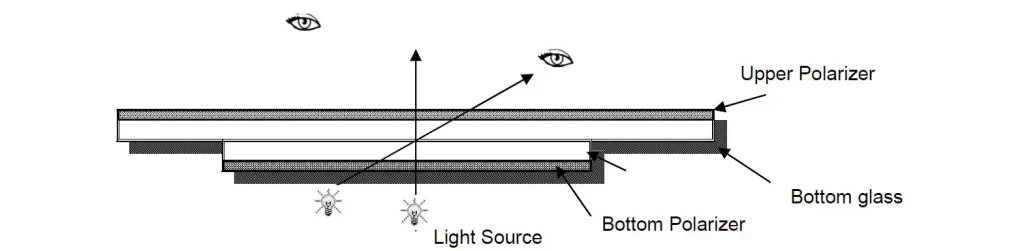
2. Definition
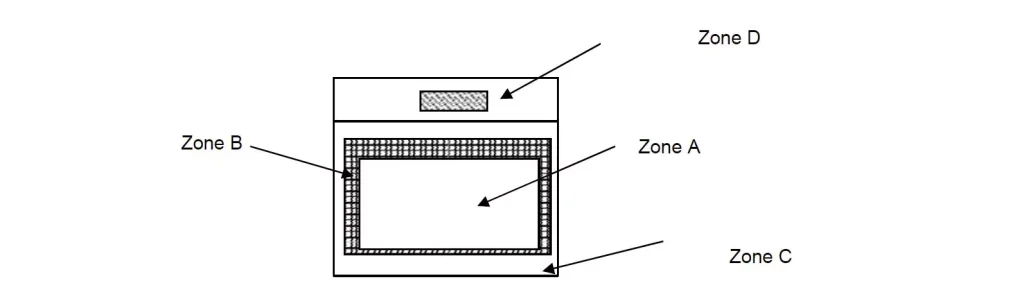
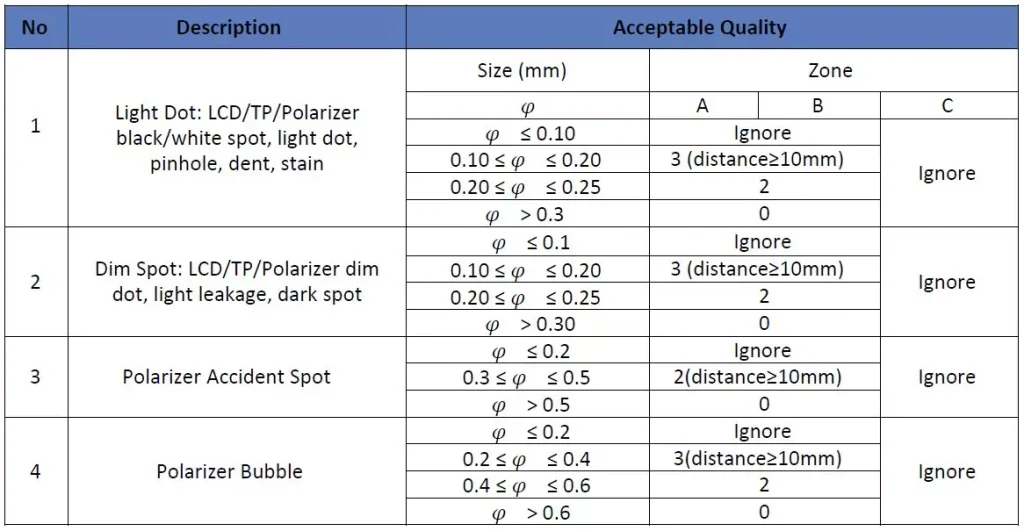
Zone A: Effective Viewing Area(Character or Digit can be seen)
Zone B: Viewing Area except Zone A
Zone C: Outside (Zone A+Zone B) which cannot be seen after assembly by customer.)
Zone D: IC Bonding Area
Note: As a general rule, visual defects in Zone C can be ignored when it doesn’t effect product function or appearance after assembly by customer.
3. Sampling Plan
According to MIL-STD-1916
AQL:
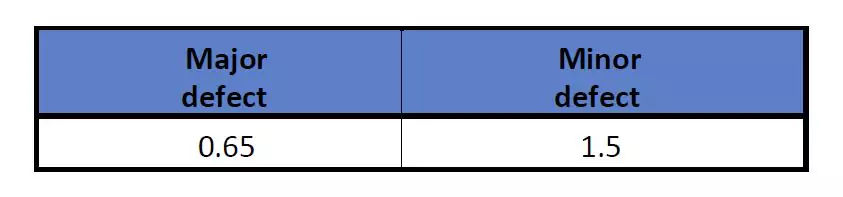
AMOLED, TP: Touch Panel, LCM: Liquid Crystal Module
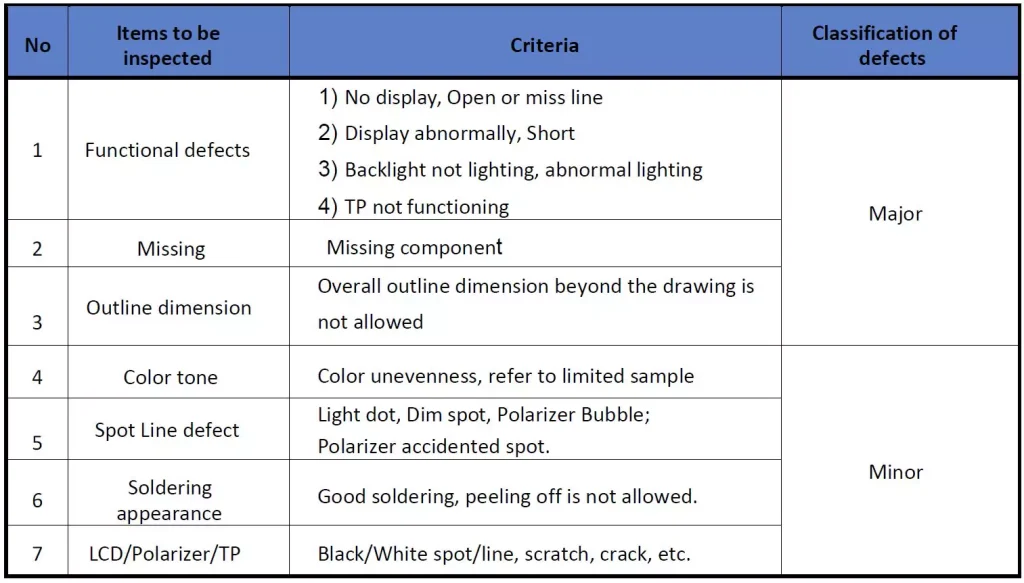
4. Criteria Visual
AMOLED Broken/Cracked:
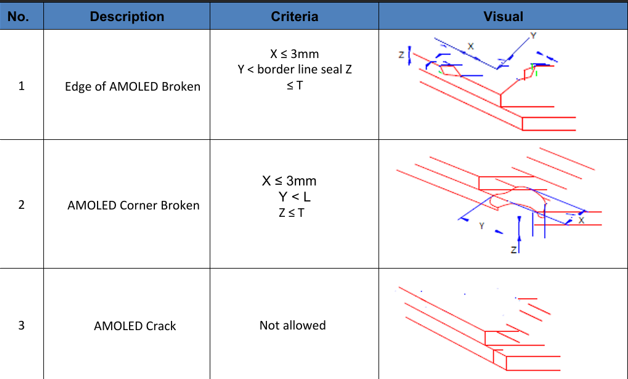
Note: X=Length, Y=Width, Z=Height, L=Length of ITO, T=Height of AMOLED
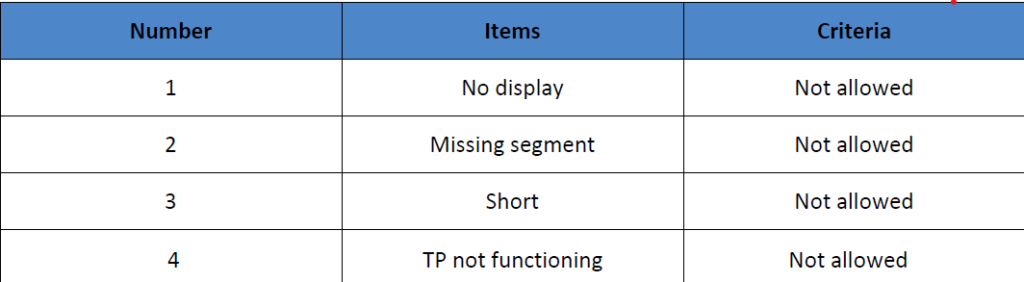
Spot Defect:
Visual:
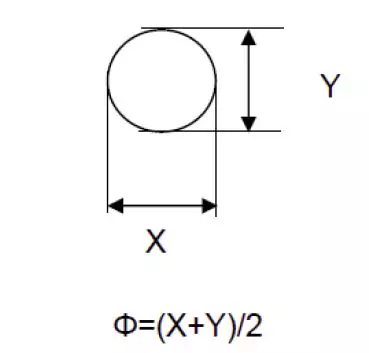
Line Defect:

5. Electronic Components SMT
According to IPC-A-610C class Ⅱ standard. Function defect and missing part are major defects, the others are minor defects.
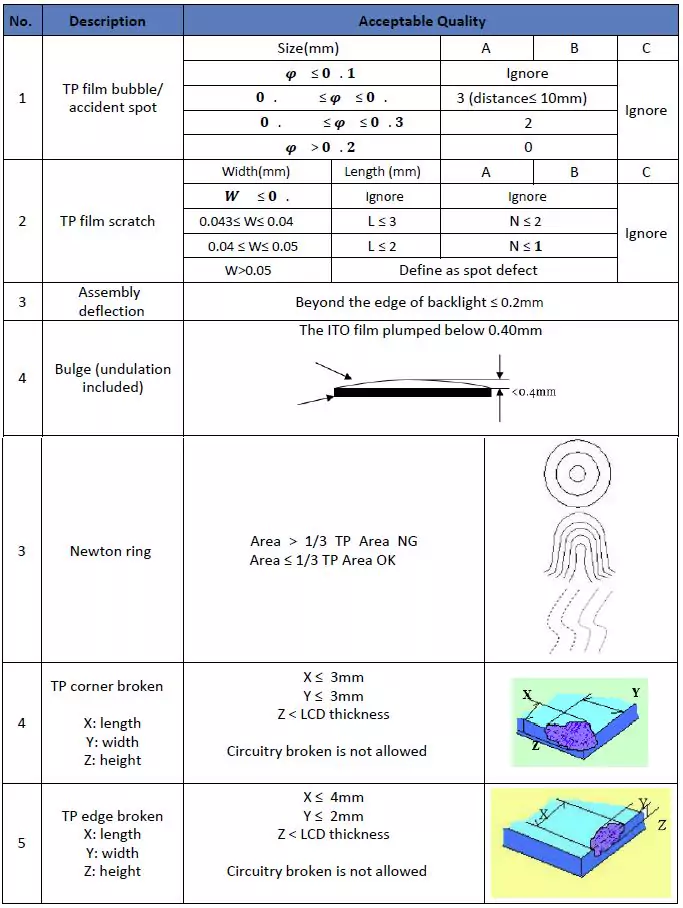
RTP Related:
6. Reliability Test Result
Conditions:
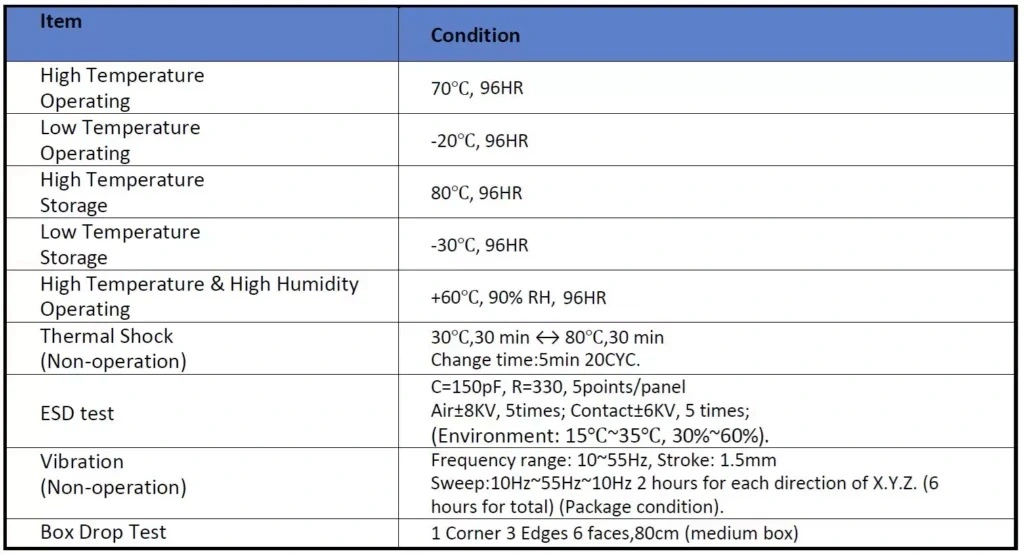
Inspection After Test: Inspection after 2-4 hours storage at room temperature, the sample shall be free from defects:
- Air bubble in AMOLED
- Non-display
- Missing segments/line;
- Glass crack
- Current IDD is twice higher than initial value
Remark:
- The test samples should be applied to only one test item.
- Sample size for each test item is 5~10pcs.
- For Damp Proof Test, Pure water (Resistance>10MΩ) should be used.
- In case of malfunction defect caused by ESD damage, if it would be recovered to normal state after resetting, it would be judged as a good part
- Failure Judgment Criterion: Basic Specification, Electrical Characteristic, Mechanical Characteristic, Optical Characteristic.
DISCLAIMER
Buyers and others who are developing systems that incorporate Focus LCDs products (collectively, “Designers”) understand and agree that Designers remain responsible for using their independent analysis, evaluation and judgment in designing their applications and that Designers have full and exclusive responsibility to assure the safety of Designers’ applications and compliance of their applications (and of all Focus LCDs products used in or for Designers’ applications) with all applicable regulations, laws and other applicable requirements.
Designer represents that, with respect to their applications, Designer has all the necessary expertise to create and implement safeguards that:
(1) anticipate dangerous consequences of failures
(2) monitor failures and their consequences, and
(3) lessen the likelihood of failures that might cause harm and take appropriate actions.
Designer agrees that prior to using or distributing any applications that include Focus LCDs products, Designer will thoroughly test such applications and the functionality of such Focus LCDs products as used in such applications.

