

LCD Cleaning and Chemical Resistance Design for OEM Displays
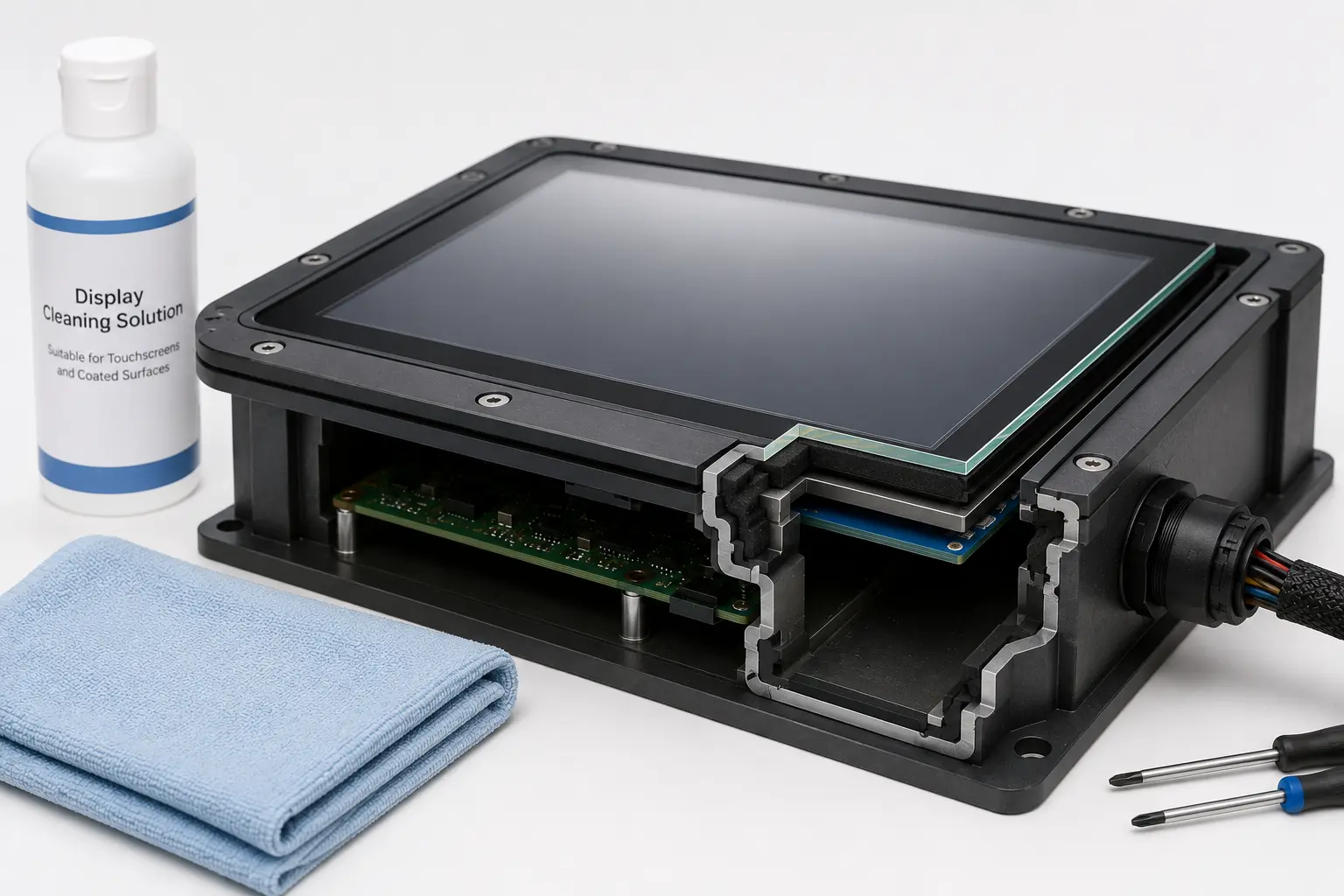
What is LCD cleaning and chemical resistance design?
LCD cleaning and chemical resistance design is the process of selecting display materials, cover glass, coatings, adhesives, gaskets, and enclosure features that can withstand cleaning agents, disinfectants, oils, moisture, and field exposure over time.
Why LCD cleaning and chemical resistance design matters in OEM systems
LCD cleaning and chemical resistance design affects display durability, readability, touch performance, coating life, sealing reliability, and long-term field performance. A display may work well in the lab, but still degrade in the field if its surface materials, adhesives, gaskets, or enclosure interfaces do not match the cleaning and chemical exposure requirements of the final product.
In medical, food service, industrial, transportation, agricultural, defense, and rugged equipment, displays often face repeated cleaning, disinfectants, oils, grease, detergents, moisture, dust, and operator handling. In regulated or safety-critical systems, display degradation can affect usability, operator input, field reliability, and service planning. Therefore, engineers should treat cleaning and chemical resistance as part of the full display architecture, not as a late-stage surface treatment decision.
Focus LCDs manufactures and supplies standard and custom LCD modules for OEM integration. In addition, Focus LCDs works with engineering teams to review cover glass, coatings, touch integration, gasket interfaces, optical stack-up, cable routing, enclosure design, and lifecycle requirements. However, final cleaning process validation, system validation, regulatory certification, and compliance remain the responsibility of the OEM.
Key Takeaways for OEM Engineers
• Cleaning exposure can affect cover glass, coatings, adhesives, gaskets, labels, cables, and enclosure materials.
• Chemical resistance should be reviewed before the cover glass, coating, gasket, and bonding method are finalized.
• Repeated cleaning may cause haze, coating wear, seal loss, touch issues, or cosmetic damage over time.
• Medical, food service, industrial, and transportation systems may require different cleaning and durability targets.
• Final validation should use the actual cleaning agents, method, frequency, display stack-up, and enclosure design.
Why Cleaning Exposure Matters in LCD Integration
Displays are often the most touched and cleaned surface in a system. This makes the display front stack more vulnerable to wear, chemical exposure, abrasion, moisture, and handling damage.
Cleaning exposure may affect:
• Cover glass
• Anti-glare coatings
• Anti-reflective coatings
• Anti-fingerprint coatings
• Touch sensors
• Optical adhesives
• Gaskets
• Edge seals
• Printed borders
• Labels and overlays
• Cable exits
• Enclosure seams
For example, a surface coating may look clear during early testing but show haze after repeated cleaning. Similarly, a gasket may seal well at first but soften, swell, or lose compression after chemical exposure.
These risks connect closely to LCD Optical Bonding and Cover Glass Design for OEM Displays and LCD Gasket and Enclosure Sealing Design for Rugged OEM Displays.
Common Cleaning and Chemical Exposure Failure Modes
Cleaning-related failures can appear as optical, touch, sealing, cosmetic, or electrical problems.
| Failure Mode | Likely Cause | System Impact |
|---|---|---|
| Surface haze | Coating wear, chemical attack, or residue | Reduced readability |
| Touch instability | Moisture, residue, grounding issue, or coating change | Poor user input |
| Coating wear | Repeated wiping, harsh cleaners, or abrasion | Reduced usability and appearance |
| Edge discoloration | Chemical ingress or adhesive reaction | Cosmetic and reliability concern |
| Fogging | Moisture ingress or poor sealing | Reduced display clarity |
| Gasket swelling | Chemical mismatch | Seal loss or enclosure stress |
| Delamination | Adhesive chemical exposure or thermal stress | Optical or mechanical failure |
| Cable or label damage | Cleaner exposure near exits or overlays | Service and reliability risk |
Because these symptoms can overlap with optical bonding, sealing, and mechanical issues, engineers should evaluate the complete display stack during root cause analysis.
Cleaning Agents and Display Material Compatibility
Different cleaning agents can affect display materials in different ways. The correct design choice depends on the product environment and the approved cleaning process.
Common exposure types include:
• Alcohol-based cleaners
• Quaternary ammonium disinfectants
• Bleach-based cleaners
• Detergents
• Degreasers
• Oils and lubricants
• Food residue
• Salt spray
• Fuel or solvent exposure
• Water and humidity
• UV exposure
• Abrasive wiping
In healthcare settings, teams often review disinfectant practices against infection-control guidance such as the CDC chemical disinfectants guidance. For OEM display programs, the key point is not only which cleaner is used, but also how often it is used, how long it remains on the surface, and whether liquid can reach edges, seams, cables, or gaskets.
How to Specify LCD Cleaning Resistance Requirements
Cleaning resistance should be defined before the display stack-up, cover glass, coating, gasket, and enclosure design are finalized. Clear requirements help engineering, quality, production, and service teams validate the same use case.
Engineers should specify:
• Approved cleaner types
• Cleaner concentration
• Dwell time on the display surface
• Wipe method and cloth type
• Cleaning frequency
• Expected exposure duration
• Operating temperature and humidity
• Glove, moisture, or residue conditions
• Touch performance expectations after cleaning
• Optical inspection criteria
• Gasket, coating, and adhesive acceptance criteria
• Validation sample size and test duration
This specification helps prevent unclear cleaning assumptions from becoming late-stage validation or field-service problems.
Cover Glass Selection for Chemical Exposure
Cover glass is often the first defense against cleaning damage. Its thickness, material, surface finish, edge quality, and coatings all affect long-term durability.
Engineers should review:
• Glass type
• Chemical strengthening
• Thickness
• Edge finish
• Scratch resistance
• Impact risk
• Coating compatibility
• Ink border durability
• Cleaning method
• Enclosure support
Chemically strengthened cover glass can improve durability for touch-heavy and rugged systems. Engineers may reference Corning chemically strengthened glass resources when reviewing cover glass options for durable electronic devices.
Cover glass design is also connected to LCD Optical Bonding and Cover Glass Design for OEM Displays.
Coatings and Surface Treatments
Coatings can improve usability and cleanability, but they must match the product environment. A coating that works in light-use indoor equipment may not last in a food service system, medical device, outdoor controller, or rugged vehicle display.
Common coating options include:
• Anti-glare coating
• Anti-reflective coating
• Anti-fingerprint coating
• Oleophobic coating
• Hydrophobic coating
• Hard coating
• Chemical-resistant coating
Oleophobic and hydrophobic coatings can help reduce fingerprints, smudges, and liquid wetting. For coating context, engineers may reference Abrisa Technologies CleanVue coating resources.
However, coatings can wear over time. Engineers should review abrasion, cleaning frequency, chemical contact time, glove use, and field conditions before choosing a surface treatment.
Optical Bonding and Adhesive Durability
Cleaning exposure can affect adhesives and bonded layers, especially near edges. If cleaning fluid reaches an adhesive interface, the display may develop haze, bubbles, edge defects, or delamination.
Engineers should review:
• OCA or LOCA material
• Edge seal design
• Bond line exposure
• Cleaning fluid path
• UV exposure
• Thermal cycling
• Adhesive compatibility
• Inspection criteria
• Rework limits
• Material change control
Optically clear adhesives require careful material and process control. Engineers may reference 3M optically clear adhesive technical resources when reviewing display bonding materials.
These decisions are closely related to Understanding the Benefits of OCA Bonding.
Gaskets, Seals, and Cleaning Fluid Ingress
Cleaning fluids often enter systems through edges, seams, cable exits, vent paths, and enclosure gaps. For this reason, gasket and sealing design must be reviewed alongside surface materials.
Engineers should check:
• Gasket material
• Compression range
• Chemical resistance
• Edge seal location
• Cable exit sealing
• Vent placement
• Enclosure seams
• Fastener pattern
• Cover glass fit
• Cleaning fluid flow path
A cleaner may not damage glass directly, but it can still affect the gasket, adhesive, label, cable, or PCB if liquid reaches the wrong area.
Sealing design is discussed further in LCD Gasket and Enclosure Sealing Design for Rugged OEM Displays.
Touch Performance After Cleaning
Touch displays need special review because moisture, residue, gloves, and cleaning agents can affect touch response. A display may pass dry-touch testing but behave differently after cleaning.
Engineers should evaluate:
• Wet-touch behavior
• Glove support
• Residue effects
• Grounding stability
• Cover glass thickness
• Coating behavior
• Touch controller tuning
• Enclosure grounding
• Cleaning frequency
• Field use conditions
In medical, food service, and industrial systems, teams should validate touch performance after repeated cleaning cycles using the final cover glass, coating, enclosure, and touch controller settings.
Cable Exits, Labels, and Printed Overlays
Cleaning exposure does not stop at the display surface. Liquid can reach cable exits, printed overlays, labels, buttons, adhesives, and nearby enclosure features.
Engineers should review:
• Flex cable exit path
• Connector protection
• Printed border durability
• Label material
• Overlay adhesive
• Keypad overlay material
• Cable strain relief
• Edge sealing
• Service access
• Cleaner pooling areas
A display system may fail because cleaning fluid enters through a cable exit or damages an overlay adhesive, even when the cover glass remains intact.
Cable and connector planning is discussed further in LCD Cable and Connector Design for Reliable OEM Integration.
Cleaning Exposure by OEM Application Type
Different markets create different cleaning and chemical exposure risks.
| OEM Application | Typical Exposure | Design Focus |
|---|---|---|
| Medical equipment | Disinfectants, gloves, repeated wiping | Chemical-resistant surface, touch validation, coating durability |
| Food service equipment | Grease, detergents, moisture, residue | Sealing, cleanability, gasket compatibility, surface durability |
| Industrial controls | Oils, dust, solvents, gloves | Rugged cover glass, sealing, touch tuning, cable protection |
| Transportation displays | UV, temperature change, cleaning agents | Coating durability, vibration, thermal stress, readability |
| Agricultural equipment | Mud, dust, water, chemicals | Sealing, rugged glass, cable protection, service access |
| Defense systems | Abrasion, field handling, environmental stress | Durability, sealing, controlled materials, lifecycle support |
This review helps teams choose materials and validation methods that match real use conditions.
Cleaning and Chemical Resistance Framework
A practical LCD cleaning and chemical resistance framework includes five areas:
• Surface design → cover glass, coating, scratch resistance, cleanability
• Optical design → haze, reflection, bonding, readability, residue control
• Sealing design → gasket material, edge seal, cable exit, enclosure seams
• Touch design → wet touch, glove use, controller tuning, grounding
• Lifecycle design → approved cleaners, material control, alternates, change review
When teams review these areas together, they can reduce field risk and improve long-term display performance.
Focus LCDs can help OEM teams review these display-specific cleaning and chemical resistance factors early so cover glass, coatings, bonding, sealing, touch performance, and lifecycle requirements are aligned before release.
Cleaning and Chemical Resistance Risk Factors
| Risk Factor | Potential Impact | Design Review Action |
|---|---|---|
| Harsh cleaning agents | Coating wear, haze, or material damage | Validate approved cleaners with final materials |
| Repeated wiping | Surface wear or scratch damage | Review coating, glass hardness, and cleaning method |
| Fluid reaching edges | Delamination or ingress | Review edge seal, gasket path, and enclosure fit |
| Chemical mismatch | Gasket swelling or adhesive failure | Check material compatibility before release |
| Cleaner residue | Touch faults or visual defects | Test touch and readability after cleaning cycles |
| Unapproved field cleaners | Unknown material risk | Define approved cleaning instructions |
| Material changes | Revalidation or field risk | Document materials, alternates, and change controls |
This table helps engineers connect cleaning exposure to design and validation decisions.
Design Review Checklist for LCD Cleaning Resistance
Before releasing a display design exposed to cleaning or chemicals, engineers should confirm:
• Approved cleaners are defined and documented
• Cleaner concentration, dwell time, wipe method, and cleaning frequency are known
• Cover glass, coatings, adhesives, gaskets, labels, and overlays match the exposure risk
• Touch performance has been tested after cleaning exposure
• Optical clarity, haze, coating wear, and cosmetic limits are defined
• Cable exits, edge seals, vents, and enclosure seams are protected from fluid paths
• Validation uses the final display stack, enclosure, gasket, coating, and cleaning process
• Long-term material availability, approved alternates, and revision controls are documented
This checklist helps teams align design, validation, manufacturing, and field-service expectations before production release.
Validation and Test Planning
Cleaning and chemical resistance should be validated with the final display stack, enclosure, gasket, coating, adhesive, cable routing, and approved cleaning method.
Validation planning may include:
• Cleaner compatibility testing
• Repeated wipe testing
• Touch testing after cleaning
• Optical inspection after exposure
• Coating wear review
• Gasket and seal inspection
• Humidity testing
• Thermal cycling
• Edge ingress inspection
• Label and overlay review
For systems with high cleaning demand, teams should test the final assembly using the actual cleaner, dwell time, wipe method, and cleaning frequency expected in the field.
Manufacturing and Assembly Control
Cleaning resistance also depends on production control. Even strong materials can fail if the bonding, coating, gasket, or surface handling process is inconsistent.
Manufacturing teams should review:
• Surface cleaning before bonding
• Coating handling
• Adhesive placement
• Gasket placement
• Edge seal inspection
• Cover glass handling
• Cosmetic criteria
• Packaging protection
• Rework limits
• Final inspection process
Clear production controls help reduce variation and protect surface durability.
Related production planning is discussed in LCD Design for Manufacturability in OEM Display Programs.
Lifecycle and Cleaning Instruction Control
Long-lifecycle OEM programs should document approved cleaning agents, material choices, alternates, and change controls. This matters because a change in cleaner, coating, gasket, adhesive, or cover glass may affect validation status.
Engineers should document:
• Approved cleaning agents
• Cleaning frequency assumptions
• Wipe method
• Material specifications
• Coating type
• Gasket material
• Adhesive system
• Approved alternates
• Revision controls
• Field service instructions
Chemical resistance planning supports long-lifecycle OEM programs where material consistency and controlled changes are critical. For long-life systems, cleaning instructions should be treated as part of the product design, not just user documentation.
Common LCD Cleaning and Chemical Resistance Mistakes
Engineers often encounter avoidable display issues during validation or field use.
Common mistakes include:
• Selecting cover glass before defining cleaning exposure
• Choosing coatings without testing cleaning agents
• Ignoring edge seal and gasket compatibility
• Validating dry touch only
• Using prototype materials during cleaning tests
• Skipping repeated wipe testing
• Overlooking cable exits and labels
• Changing cleaners after validation
• Allowing field teams to use unapproved chemicals
• Missing material change control
Although these issues may seem small during development, they can create field failures, visual defects, and service problems.
How to Debug Cleaning-Related LCD Issues
Cleaning-related failures can look like optical, touch, sealing, or material problems. A structured process helps identify the root cause.
- Identify the symptom
Check whether the issue appears as haze, coating wear, touch instability, fogging, delamination, discoloration, or seal damage. - Confirm the cleaning method
Review the cleaner, concentration, dwell time, wipe method, cleaning frequency, and field instructions. - Inspect the display stack
Check cover glass, coating, adhesive edge, gasket, printed border, cable exit, and enclosure seam. - Compare with a known-good unit
Use a known-good assembly to separate display, coating, gasket, adhesive, and enclosure issues. - Repeat exposure testing
Test with the actual cleaner and method under expected field conditions. - Confirm the corrective action
Validate the fix using final materials, production assembly steps, and updated cleaning instructions.
This process helps separate cleaning damage from LCD module, touch controller, optical bonding, gasket, or enclosure issues.
Focus LCDs Engineering Approach
Focus LCDs manufactures and supplies standard and custom LCD modules and works with OEM engineering teams to align cleaning exposure, cover glass, coatings, touch integration, sealing, and lifecycle requirements.
This includes support for custom LCD modules, cover glass planning, touch integration, optical stack-up review, gasket interface review, cable coordination, coating considerations, and display-related subassemblies where appropriate.
By reviewing cleaning and chemical resistance requirements early, Focus LCDs helps OEM teams reduce integration risk, improve field durability, and support reliable display operation in medical, food service, industrial, rugged, and long-lifecycle systems. This engineering-led display integration support is intended for OEM teams that require long-term program stability rather than lowest-cost sourcing.
Scope Boundary and Compliance Responsibility
Focus LCDs provides LCD modules and engineering guidance for integration. However, Focus LCDs does not control final OEM enclosure design, cleaning process validation, chemical exposure validation, regulatory certification, or compliance testing.
OEMs remain responsible for validating cleaning compatibility, display performance, safety, and compliance within their complete system architecture.
Contact Focus LCDs
If you are developing a display system where cleaning exposure, chemical resistance, touch durability, or long-term field reliability is critical, Focus LCDs can support display selection, custom module planning, and integration strategy.
Contact Focus LCDs: https://focuslcds.com/contact
FAQ: LCD Cleaning and Chemical Resistance Design
What is LCD cleaning and chemical resistance design?
LCD cleaning and chemical resistance design helps ensure that display materials, coatings, gaskets, adhesives, and enclosure interfaces can withstand approved cleaning agents and field exposure.
Why does cleaning exposure matter for LCD modules?
Cleaning exposure can affect cover glass, coatings, touch response, gaskets, adhesives, labels, overlays, and sealing performance.
Can disinfectants damage LCD displays?
Yes. Some disinfectants can wear coatings, soften gaskets, affect adhesives, leave residue, or cause haze if the display materials are not compatible.
How should engineers validate LCD cleaning resistance?
Engineers should test the final display assembly with the actual cleaner, wipe method, dwell time, cleaning frequency, enclosure design, and touch settings.
Does cover glass improve chemical resistance?
Cover glass can help protect the display, but its coating, edge design, thickness, and enclosure fit must still match the cleaning environment.
Can cleaning affect touch performance?
Yes. Moisture, residue, coatings, gloves, and grounding conditions can affect touch response, so touch testing should be done after cleaning exposure.
When should cleaning requirements be reviewed?
Cleaning requirements should be reviewed early, before cover glass, coatings, gaskets, adhesives, bonding method, and enclosure design are finalized.
Conclusion: Cleaning Resistance Supports Long-Term Display Reliability
LCD cleaning and chemical resistance design directly affects readability, touch performance, sealing, surface durability, and long-term reliability.
By reviewing cleaning agents, cover glass, coatings, adhesives, gaskets, cable exits, touch behavior, and lifecycle controls early, OEM teams can reduce validation delays and prevent field issues.
In medical, food service, industrial, and rugged systems, cleaning resistance is not only a surface concern. It is a core part of successful LCD integration.

