

LCD Optical Bonding and Cover Glass Design for OEM Displays
What is LCD optical bonding and cover glass design?
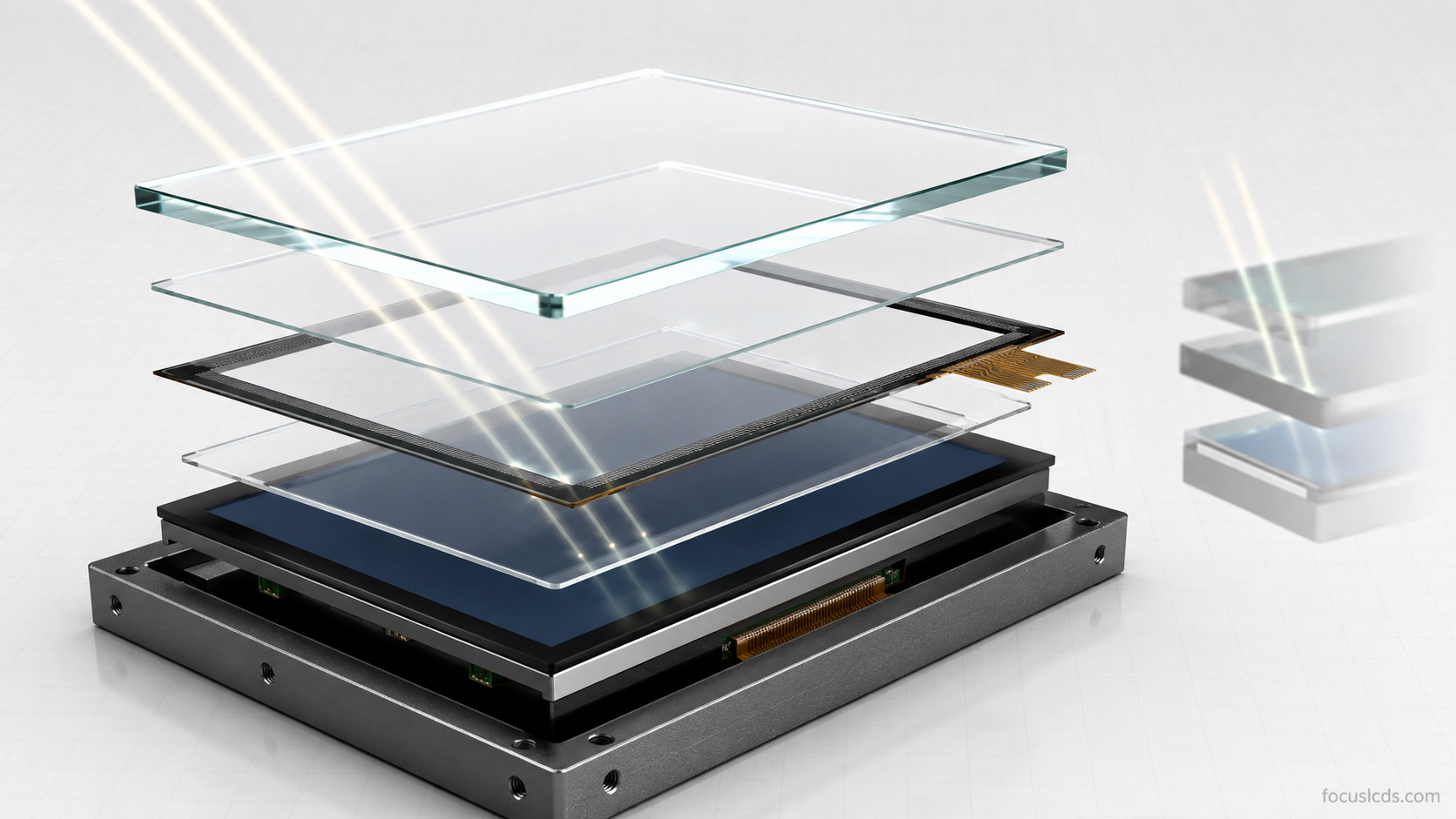
LCD optical bonding and cover glass design is the process of selecting the protective front surface, bonding method, and optical stack-up that help improve display readability, durability, touch performance, and long-term reliability in OEM systems.
Why LCD optical bonding and cover glass design matters in OEM systems
LCD optical bonding and cover glass design affects how well a display performs in real-world environments. A display may meet electrical and mechanical requirements, but still fail to deliver reliable visibility or field durability if the front stack-up is not designed correctly.
In industrial, medical, defense, transportation, agricultural, food service, and rugged equipment, displays often face sunlight, glare, vibration, impact, cleaning chemicals, moisture, dust, and repeated touch use. Therefore, engineers should treat optical bonding and cover glass design as part of the complete display architecture, not as a late-stage cosmetic choice.
Focus LCDs manufactures and supplies standard and custom LCD modules for OEM integration. In addition, Focus LCDs works with engineering teams to evaluate cover glass requirements, bonding options, touch panel integration, viewing conditions, mechanical constraints, and lifecycle goals. However, final system validation, certification, and compliance remain the responsibility of the OEM.
Why Optical Bonding Matters in LCD Integration
LCD modules often include several front-layer elements, such as the LCD glass, air gap, touch panel, adhesive layer, cover glass, coating, and enclosure interface. Each layer can affect optical quality, durability, and production consistency.
Without proper front-stack design, displays may show glare, reflection, reduced contrast, dust intrusion, fogging, Newton rings, or lower outdoor readability. In rugged systems, the same stack-up can also affect impact resistance and vibration performance.
Optical bonding helps reduce the air gap between the LCD and front surface. As a result, it can improve contrast, reduce internal reflections, and support better readability in bright environments. These benefits are also discussed in Understanding the Benefits of OCA Bonding.
When Should OEMs Choose Optical Bonding?
OEMs should consider optical bonding when the display must support strong readability, touch performance, durability, or environmental protection. This is especially important for outdoor equipment, medical interfaces, defense systems, transportation displays, rugged controllers, and touch-heavy operator panels.
Optical bonding may be a strong fit when the system needs:
• Improved sunlight readability
• Reduced internal reflections
• Better contrast
• Stronger front-stack durability
• Reduced dust or moisture risk between layers
• Improved touch response through the final stack-up
• Better performance in rugged or high-use environments
However, optical bonding is not always required. In controlled indoor systems, low-glare environments, or designs where serviceability and lower optical stress are more important, an air-gap display may be suitable. Engineers should choose the front-stack approach based on the use environment, reliability goals, optical needs, service plan, and validation requirements.
Air Gap vs Optical Bonding
The decision between an air-gap display and an optically bonded display should depend on the use case, environment, cost target, service needs, and reliability goals.
| Design Option | Best Fit | Key Considerations |
|---|---|---|
| Air gap | Controlled indoor environments, lower optical stress, simpler builds | More internal reflection, higher risk of dust or moisture between layers |
| OCA bonding | Flat displays, consistent optical stack-up, thinner assemblies | Requires controlled lamination and good surface preparation |
| LOCA bonding | Irregular surfaces, some cover glass or touch applications, complex bonding needs | Requires controlled dispensing, curing, and process validation |
| Optical bonding with cover glass | Rugged, outdoor, medical, industrial, or touch-heavy systems | Requires review of glass thickness, coating, adhesive, and enclosure fit |
Engineers should review these tradeoffs before enclosure design, touch panel selection, and validation planning are finalized.
OCA and LOCA Bonding Methods
Optical bonding commonly uses either optically clear adhesive film or liquid optically clear adhesive.
OCA Bonding
OCA bonding uses a clear adhesive film between display layers. It can support clean lamination, stable layer thickness, and strong optical clarity when the surfaces are flat and the process is controlled.
Engineers may reference 3M optically clear adhesive technical resources when reviewing adhesive options for electronic displays.
LOCA Bonding
LOCA bonding uses a liquid adhesive that fills the space between display layers before curing. This method can help with some complex shapes, cover lens designs, or assemblies that need better gap filling.
For display bonding context, engineers may reference Henkel optical bonding for automotive displays, especially when reviewing liquid optically clear adhesive use in display assemblies.
Both methods require process control. Poor bonding can cause bubbles, haze, delamination, mura, edge defects, or uneven optical performance.
Cover Glass Design Considerations
Cover glass protects the display and helps define the user-facing surface. It can also affect touch performance, brightness, reflection, durability, and enclosure fit.
Engineers should review:
• Glass thickness
• Glass type
• Chemical strengthening
• Edge finish
• Coatings
• Ink border design
• Touch panel position
• Bonding method
• Impact requirements
• Cleaning exposure
• Enclosure pressure
Cover glass selection should match the product environment. A medical device, outdoor controller, rugged vehicle display, and food service interface may each require different cover glass choices.
For cover glass material context, engineers may reference AGC Dragontrail cover glass resources, which describe strengthened cover glass used for electronic devices.
Coatings and Surface Treatments
Coatings can improve usability, readability, and durability. However, each coating introduces tradeoffs that engineers should review during design.
Common options include:
• Anti-glare coating
• Anti-reflective coating
• Anti-fingerprint coating
• Hard coating
• Oleophobic coating
• Hydrophobic coating
• Chemical-resistant surface treatment
For outdoor systems, anti-reflective or anti-glare treatments can help improve readability. In touch-heavy systems, anti-fingerprint or hard coating options may improve user experience and service life.
However, coatings must match the operating environment. Cleaning chemicals, abrasion, gloves, moisture, and UV exposure can affect long-term surface performance.
Optical Performance and Readability
Optical bonding and cover glass design directly affect how users see the display.
Key optical factors include:
• Contrast ratio
• Reflectance
• Brightness
• Viewing angle
• Haze
• Transmittance
• Color shift
• Sunlight readability
• Touch visibility
• Uniformity
A brighter backlight alone does not always solve readability problems. If the front stack-up creates too much reflection, the display may still be hard to read in sunlight.
For high-brightness display design context, see Criteria for Developing High Brightness LCDs.
Touch Panel Integration
Touch performance depends on the full front stack-up. Cover glass thickness, adhesive layer, touch sensor position, grounding, and controller tuning can all affect touch response.
Engineers should review:
• Touch sensor type
• Cover glass thickness
• Glove support
• Wet-touch behavior
• Noise immunity
• Adhesive thickness
• Controller tuning
• Grounding strategy
• Enclosure effects
Thicker cover glass may improve durability, but it can also affect touch sensitivity. In medical, industrial, and outdoor systems, teams should validate touch performance with gloves, moisture, cleaning procedures, and the final enclosure.
Mechanical Reliability in Bonded LCD Assemblies
Optical bonding and cover glass design affect mechanical reliability. Bonded stacks can improve stiffness and reduce the chance of debris entering the display cavity, but they also require careful review of stress, edge design, and enclosure loading.
Engineers should evaluate:
• Glass edge treatment
• Bond line thickness
• Adhesive modulus
• Enclosure compression
• Drop or impact risk
• Vibration exposure
• Thermal expansion
• Mounting pressure
• Service handling
Rugged display systems should avoid designs that place uneven pressure on the cover glass or bonded stack. Mechanical reliability is closely related to LCD Glass Selection for Vibration in Rugged OEM Systems and Rugged LCD Design for Harsh and Safety-Critical Applications.
Thermal and Environmental Considerations
Temperature, UV exposure, moisture, and chemical exposure can affect optical bonding and cover glass performance over time.
Common environmental risks include:
• Adhesive yellowing
• Delamination
• Moisture intrusion
• Fogging
• Coating wear
• UV degradation
• Thermal expansion mismatch
• Edge seal failure
• Cleaning chemical damage
In sealed systems, heat from the backlight and enclosure can increase stress on the optical stack. Therefore, engineers should review thermal behavior together with bonding method, cover glass, and enclosure design.
Thermal planning is discussed further in LCD Thermal Modeling in Enclosures for OEM Reliability.
Lifecycle and Material Control
Optical bonding and cover glass design also require lifecycle planning. Material selection should account for long-term availability, approved alternates, and controlled changes over the program lifecycle.
For long-lifecycle OEM systems, changes to adhesive, coating, cover glass, touch sensor, or surface treatment may affect optical performance, touch behavior, durability, and validation status. Because of this, engineers should document key material choices and review any changes before production release or field deployment.
Manufacturability and Process Control
Optical bonding and cover glass design must support repeatable production. A stack-up that works in a prototype may not remain stable unless the bonding process, materials, inspection criteria, and handling steps are well defined.
Manufacturing teams should review:
• Surface cleaning
• Adhesive placement
• Lamination method
• Bubble control
• Curing process
• Edge control
• Inspection criteria
• Rework limits
• Cosmetic standards
• Packaging and handling
Small process changes can affect haze, bubbles, edge defects, dust control, and final appearance. Because of this, optical bonding decisions should be part of the manufacturability review, not a late-stage production fix.
Related production planning is discussed in LCD Design for Manufacturability in OEM Display Programs.
Optical Bonding and Cover Glass Risk Factors
| Risk Factor | Potential Impact | Design Review Action |
|---|---|---|
| Excess reflection | Poor sunlight readability | Review bonding method, coatings, brightness, and cover glass |
| Poor adhesive control | Bubbles, haze, or delamination | Define bonding process and inspection criteria |
| Thick cover glass | Reduced touch sensitivity | Validate touch controller tuning and final stack-up |
| Weak edge design | Cracking or chipping | Review edge finish, mounting pressure, and enclosure fit |
| Chemical exposure | Coating wear or haze | Validate cleaning agents and surface treatments |
| Thermal stress | Delamination or optical distortion | Review backlight heat, enclosure design, and adhesive behavior |
| Loose enclosure fit | Dust or moisture intrusion | Review sealing, gasket compression, and mechanical stack-up |
This table helps teams connect optical symptoms to design decisions before validation begins.
Design Framework for Optical Bonding and Cover Glass
A practical optical bonding and cover glass framework includes five areas:
• Optical design → reflection, brightness, contrast, haze, readability
• Mechanical design → glass thickness, edge finish, enclosure pressure
• Touch design → cover thickness, controller tuning, glove and wet use
• Environmental design → UV, moisture, heat, chemicals, cleaning
• Manufacturing design → bonding process, inspection, cosmetic limits, rework
When teams review these areas together, they can reduce display risk and improve field performance.
Focus LCDs can help OEM teams review these optical stack-up factors early so cover glass, bonding method, touch performance, and enclosure requirements are aligned before release.
Optical Bonding and Cover Glass Checklist
Before releasing an LCD front-stack design, engineers should confirm:
• The bonding method matches the display size and surface geometry
• Cover glass thickness matches durability and touch needs
• Coatings match the use environment and cleaning method
• Optical performance meets brightness and readability goals
• Touch performance works through the final stack-up
• Enclosure pressure does not stress the bonded assembly
• Thermal conditions do not create adhesive or optical risk
• Inspection criteria cover bubbles, haze, dust, edge quality, and cosmetic limits
• Validation uses the final cover glass, adhesive, coating, and enclosure design
• Lifecycle plans include material availability and approved changes
This checklist helps teams find optical and mechanical risks before production release.
Common Optical Bonding and Cover Glass Mistakes
Engineers often encounter avoidable issues during display integration.
Common mistakes include:
• Choosing cover glass before defining touch requirements
• Treating optical bonding as only a cosmetic option
• Ignoring glare and reflection in outdoor use
• Selecting a coating without checking cleaning exposure
• Using prototype stack-ups during validation
• Applying uneven enclosure pressure to the cover glass
• Skipping edge design review
• Failing to validate glove or wet-touch performance
• Changing adhesive or glass materials without revalidation
Although these mistakes may seem small during development, they can create field failures, poor readability, and late-stage redesign.
How to Debug Optical Bonding and Cover Glass Issues
Optical and cover glass faults can look like display, touch, or mechanical problems. A structured process helps narrow the root cause.
- Identify the visible symptom
Check whether the issue appears as glare, haze, bubbles, dust, delamination, poor touch response, or reduced readability. - Compare with a known-good assembly
Use a known-good display stack to separate panel issues from bonding, coating, or enclosure problems. - Review the front stack-up
Confirm cover glass thickness, adhesive type, coating, air gap, touch sensor position, and enclosure fit. - Check environmental triggers
Test the issue under temperature, UV exposure, humidity, cleaning agents, and real lighting conditions. - Inspect mechanical stress points
Look for uneven gasket pressure, edge loading, tight mounting, or enclosure contact with the cover glass. - Validate touch and optical performance together
Confirm readability, touch response, glove use, wet use, and brightness performance using the final assembly.
This process helps separate optical stack-up problems from LCD panel, touch controller, firmware, or enclosure issues.
Focus LCDs Engineering Approach
Focus LCDs manufactures and supplies standard and custom LCD modules and works with OEM engineering teams to align optical bonding, cover glass, touch integration, and mechanical design with system requirements.
This includes support for custom LCD modules, cover glass planning, touch integration, cable coordination, display-related subassemblies, optical stack-up review, bonding method coordination, coatings, mechanical fit, and long-term program needs.
By reviewing optical bonding and cover glass requirements early, Focus LCDs helps OEM teams reduce integration risk, improve readability, and support reliable display operation in rugged, regulated, and long-lifecycle systems. This engineering-led display integration support is intended for OEM teams that require long-term program stability rather than lowest-cost sourcing.
Scope Boundary and Compliance Responsibility
Focus LCDs provides LCD modules and engineering guidance for integration. However, Focus LCDs does not control final OEM enclosure design, system validation, cleaning process validation, regulatory certification, or compliance testing.
OEMs remain responsible for validating display performance, safety, and compliance within their complete system architecture.
Contact Focus LCDs
If you are developing a system where readability, cover glass durability, touch performance, or optical bonding reliability is critical, Focus LCDs can support display selection, custom module planning, and integration strategy.
Contact Focus LCDs: https://focuslcds.com/contact
FAQ: LCD Optical Bonding and Cover Glass Design
What is LCD optical bonding?
LCD optical bonding joins display layers with a clear adhesive to reduce air gaps, improve contrast, reduce reflections, and support better display readability.
Why does cover glass design matter for LCD modules?
Cover glass design affects durability, touch response, readability, chemical resistance, impact protection, and enclosure fit.
What is the difference between OCA and LOCA bonding?
OCA uses a clear adhesive film, while LOCA uses a liquid adhesive that cures after filling the gap between display layers.
Does optical bonding improve sunlight readability?
Yes. Optical bonding can reduce internal reflections and improve contrast, which helps display readability in bright or outdoor environments.
Is optical bonding always required?
No. Optical bonding is not always required. Air-gap designs may work well in controlled indoor environments or systems where serviceability, simpler assembly, or lower optical stress are more important.
Can thicker cover glass affect touch performance?
Yes. Thicker cover glass can reduce touch sensitivity, so engineers should validate touch controller tuning with the final stack-up.
When should optical bonding and cover glass be validated?
They should be validated before production release using the final LCD module, adhesive, cover glass, coating, touch panel, and enclosure design.
Conclusion: Optical Stack-Up Design Supports Display Reliability
LCD optical bonding and cover glass design directly affect readability, durability, touch performance, and long-term reliability.
By reviewing bonding method, cover glass thickness, coatings, touch behavior, mechanical stress, environmental exposure, and lifecycle needs early, OEM teams can reduce validation delays and improve field performance.
In rugged and reliability-first systems, the display front stack is not only a visual layer. It is a core part of successful LCD integration.

