

LCD Design for Manufacturability in OEM Display Programs
What is LCD design for manufacturability?
LCD design for manufacturability helps OEM teams design display modules that production teams can build, assemble, test, and support with consistent results across the product lifecycle.
Why LCD design for manufacturability matters in OEM systems
LCD design for manufacturability helps OEM teams reduce production risk before a display reaches validation or full production. A display may work during early bring-up, but still create problems later if the mechanical fit, cable path, interface choice, optical stack-up, backlight design, or supply plan is not ready for repeatable production.
In industrial, medical, defense, transportation, agricultural, and food service equipment, these risks can delay validation and increase redesign work. In safety-critical and reliability-first OEM equipment, display changes can also affect uptime, field service expectations, and revalidation planning. Therefore, engineers should review manufacturability early, not after the display design is already locked.
Focus LCDs manufactures and supplies standard and custom LCD modules for OEM integration. In addition, Focus LCDs works with engineering teams to evaluate display type, mechanical constraints, interface requirements, optical needs, backlight design, and lifecycle goals. However, final system validation, certification, manufacturing process validation, and compliance remain the responsibility of the OEM.
Why Manufacturability Matters in LCD Integration
A display that works in a prototype is not always ready for production. Prototype builds often rely on manual adjustments, short sample runs, or temporary cable routing that may not match the final product.
Small changes in connector position, flex cable bend radius, gasket pressure, adhesive placement, or cover glass fit can affect display behavior. Once production volume increases, those small details can become repeat quality issues.
As a result, LCD design for manufacturability helps engineers find production risks before they become validation failures or field problems. These decisions are closely related to long-term display planning, as discussed in LCD Lifecycle Risk Management for OEM Programs.
Core Elements of LCD Design for Manufacturability
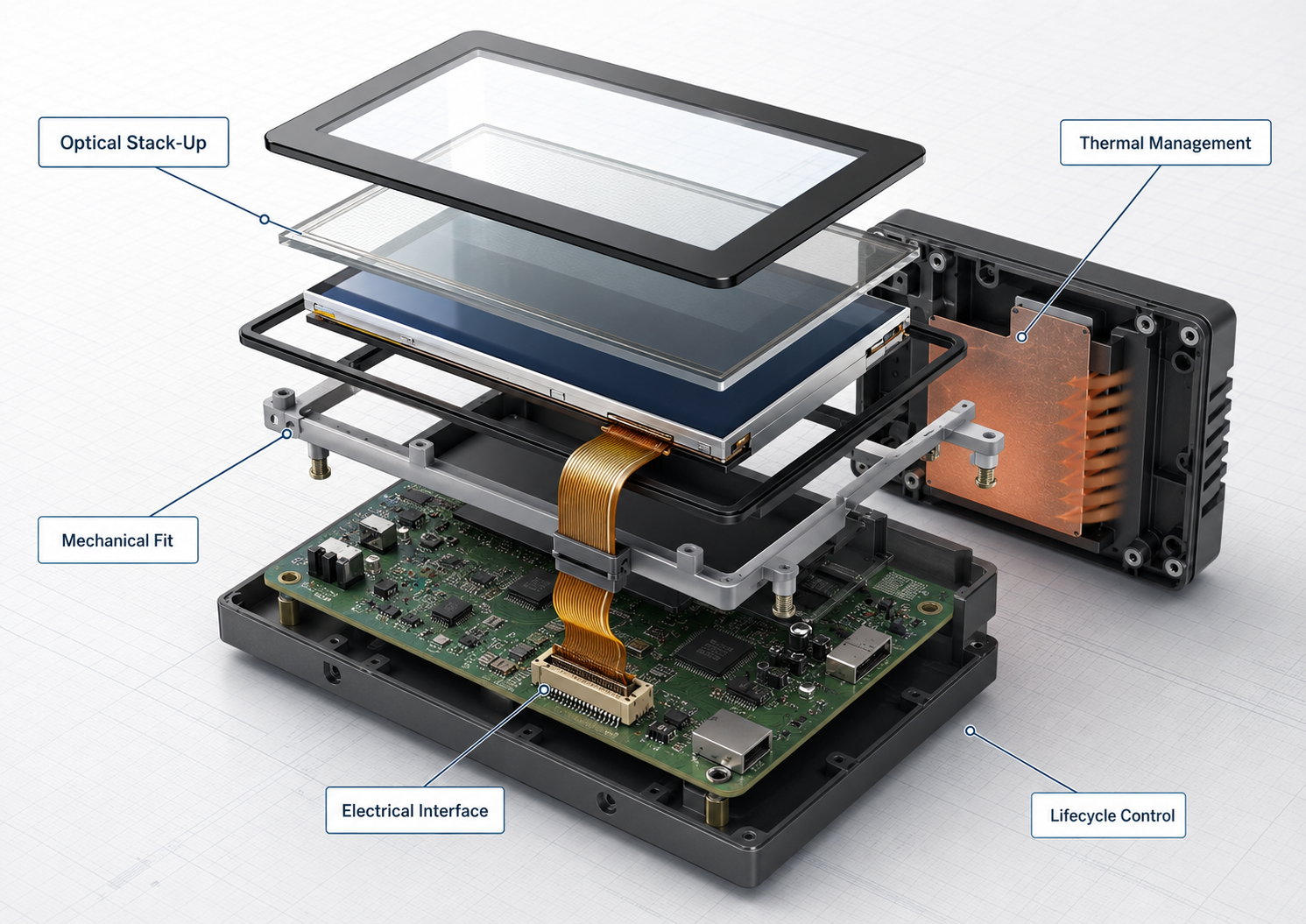
Effective LCD DFM requires alignment across mechanical, electrical, optical, thermal, and lifecycle factors. Each area affects how well the display can move from prototype to production.
Mechanical Fit and Assembly Control
Mechanical design affects how consistently teams can install the display into the final system. If the fit is too tight, assembly variation can place stress on the LCD glass, touch panel, flex cable, or connector.
Engineers should review:
- Mounting hole locations
- Bezel and enclosure tolerances
- Stack height
- Gasket compression
- Connector access
- Cable bend radius
- Cover glass fit
- Touch panel alignment
In rugged systems, vibration and shock can make small mechanical weaknesses more severe. Therefore, teams should review mechanical fit before they finalize enclosure design and tooling.
Mechanical reliability is closely related to LCD Glass Selection for Vibration in Rugged OEM Systems.
Electrical Interface Manufacturability
Electrical manufacturability depends on whether teams can route, connect, test, and repeat the display interface with stable results.
High-speed interfaces such as MIPI DSI and LVDS require controlled routing, stable grounding, and predictable connector behavior. Simpler interfaces may reduce layout demands, but they still require correct timing, power sequencing, and documentation.
During review, engineers should check:
• Interface type
• Connector pinout
• Cable length
• Ground continuity
• Signal routing limits
• Test access points
• Power sequencing
• Production test coverage
Poor interface planning can lead to signal errors, EMI issues, or intermittent failures during validation. These risks are discussed further in MIPI DSI Signal Integrity Basics for Reliable LCD Integration.
Optical Stack-Up and Production Repeatability
Optical performance must stay stable across production builds. Brightness, contrast, viewing angle, bonding quality, coatings, cover lens choice, and touch panel alignment all affect how the display performs in the final product.
Production optical issues may include:
- Brightness variation
- Uneven illumination
- Bonding defects
- Glare or reflection problems
- Touch panel alignment issues
- Cosmetic variation
- Viewing-angle mismatch
These issues are not only visual. In medical, industrial, defense, and transportation systems, inconsistent optical performance can affect usability, operator confidence, validation results, and service expectations.
Because of this, engineers should review optical stack-up decisions before teams complete tooling, enclosure design, and qualification planning.
Backlight and Thermal Manufacturability
Backlight design has a major effect on manufacturability because it affects power draw, heat rise, brightness stability, and long-term reliability.
High-brightness displays may need stronger backlight drive circuits, better thermal paths, and careful LED derating. If teams delay this review, production units may show brightness variation, faster aging, or thermal stress.
Thermal behavior is especially important in sealed enclosures, outdoor systems, food service equipment, transportation equipment, and rugged applications where airflow is limited. Related design factors are discussed in LCD Thermal Modeling in Enclosures for OEM Reliability.
Lifecycle and Change Control
LCD design for manufacturability also depends on how well the display can be supported over time. Long-lifecycle OEM programs need more than a working display sample. They need clear drawings, controlled changes, stable sourcing assumptions, and revision discipline.
A complete manufacturability review should include:
- BOM stability
- Revision control
- Obsolescence planning
- Approved alternate parts
- Controlled supplier transitions
- Documentation of critical display assumptions
This step matters in regulated, rugged, and long-lifecycle programs because a display change may require revalidation or customer approval.
How Display Type Affects LCD Manufacturability
Different LCD types create different manufacturability risks. Therefore, teams should review display type early in the design process.
TFT LCD Modules
TFT displays often involve higher data rates, backlight power, optical stack-up decisions, touch panel alignment, and tighter mechanical packaging. As a result, teams must review interface routing, thermal behavior, cover glass, bonding, and cable strain early.
Monochrome Graphic LCDs
Monochrome graphic displays may use simpler interfaces and lower power, but they still require stable contrast, viewing performance, connector alignment, and controller compatibility. In long-life equipment, supply stability and revision control are also important.
Character LCDs
Character LCDs are often mechanically simple, but production consistency still depends on mounting, connector access, viewing angle, and backlight setup. Small mechanical changes can affect readability and service fit.
Custom Segment LCDs
Custom segment displays require careful review of glass tooling, icons, pinout, drive method, viewing mode, polarizer selection, and assembly process. Once tooling is released, late design changes can affect cost, schedule, and validation.
This is why LCD DFM should consider both the display technology and the full system environment.
Manufacturing Risk Factors in LCD Module Design
LCD manufacturing risks often come from small details that are easy to miss during early development. A strong LCD design for manufacturability process turns those details into clear review actions.
| Manufacturing Risk | Potential Impact | Recommended DFM Control |
|---|---|---|
| Tight enclosure tolerances | Glass stress or assembly difficulty | Review stack-up, gasket compression, and clearance early |
| Poor cable routing | Connector strain or intermittent operation | Define bend radius, strain relief, and cable path before prototype release |
| Uncontrolled optical stack-up | Brightness or appearance variation | Lock optical needs, bonding method, and cover lens assumptions |
| Weak thermal path | Backlight aging or thermal instability | Validate heat rise, backlight current, and enclosure thermal limits |
| Late interface changes | PCB rework or validation delay | Confirm interface type, pinout, and routing limits before PCB release |
| Incomplete documentation | Production inconsistency | Maintain drawings, revision history, test criteria, and key assumptions |
| Unplanned component changes | Requalification or field-support risk | Review BOM stability, alternates, lifecycle status, and change control |
Since these risks interact, engineers should treat manufacturability as a system-level review rather than a final production check.
LCD Design for Manufacturability Framework
A practical LCD design for manufacturability framework includes five core areas:
- Mechanical design → fit, mounting, stack-up, cable routing
- Electrical design → interface, grounding, power, test access
- Optical design → bonding, brightness, coatings, viewing performance
- Thermal design → backlight heat, enclosure rise, derating plan
- Lifecycle design → BOM stability, documentation, revision control, obsolescence planning
When teams review these areas together, they can reduce production risk and improve long-term display consistency.
Focus LCDs can help OEM teams review these display-specific factors early so mechanical, electrical, optical, thermal, and lifecycle requirements align before release.
DFM Review Timing for OEM Display Programs
Teams should review manufacturability throughout the program, not only before production release.
| Program Stage | DFM Review Focus |
|---|---|
| Concept | Display type, size, interface, brightness, enclosure limits |
| Prototype | Mechanical fit, cable routing, electrical behavior, optical stack-up |
| Validation | Thermal performance, EMI behavior, environmental stress, repeatability |
| Production Release | Drawings, BOM control, test criteria, supplier readiness, revision control |
| Lifecycle Support | Obsolescence planning, approved alternates, documentation updates, change management |
This timing framework helps engineers identify manufacturability risks before they become validation failures or production delays.
Design-for-Manufacturing Questions Engineers Should Ask
Before moving from prototype to production, engineers should ask:
- Can the display be assembled without stressing the glass, touch panel, or flex cable?
- Are connectors easy to access and protected from strain?
- Does the interface support stable routing and test access?
- Is the backlight design suitable for the thermal conditions?
- Can optical performance stay consistent across production lots?
- Do component choices match the product lifecycle?
- Is the BOM stable enough for long-term production?
- Have teams documented revision controls and approved alternates?
- Will the documentation support future production builds?
This review helps prevent late-stage redesign and supports more predictable production outcomes.
How LCD DFM Supports Validation
Manufacturability affects validation because test results must reflect the final production setup. If the prototype differs from production intent, validation may miss the real risks.
For example, a display may pass early testing with hand-routed cables but fail after production cable routing changes. Similarly, a prototype may pass thermal testing before the final gasket, cover lens, keypad overlay, or enclosure stack-up is installed.
Therefore, validation builds should match production intent as early as possible. This is especially important in long-lifecycle programs where display changes can affect qualification, service plans, and supply continuity.
Lifecycle planning is discussed further in LCD Lifecycle Risk Management for OEM Programs.
Design-for-Reliability and Manufacturability
LCD design for manufacturability is closely connected to design-for-reliability. If a display is hard to assemble in a consistent way, it is more likely to show field variation over time.
Common reliability risks include:
• Cable fatigue
• Connector loosening
• Backlight degradation
• Heat-related drift
• Glass stress
• EMI sensitivity
• Touch alignment issues
• Cosmetic variation
• Uneven enclosure pressure
In safety-critical and regulated systems, these risks can extend beyond display performance. They can affect uptime, service planning, validation schedules, and customer trust.
For this reason, design-for-manufacturability should begin during early display planning, not after a design is already locked.
External Manufacturing References for OEM Engineers
Engineering teams use manufacturability practices across electronics, defense, and manufacturing programs. Engineers may reference NIST Manufacturing Extension Partnership resources for manufacturing improvement and risk reduction guidance.
For defense and high-reliability programs, the DoD Producibility and Manufacturability Engineering Guide provides useful context for reviewing production readiness earlier in development.
In addition, engineers can use Global Electronics Association standards resources when PCB assembly, workmanship, and documentation discipline affect product consistency.
Common LCD Design for Manufacturability Mistakes
Engineers often encounter avoidable manufacturability issues during the move from prototype to production.
For example:
- Choosing a display before defining enclosure limits
- Ignoring cable bend radius and connector access
- Treating optical bonding as a late-stage option
- Underestimating thermal impact from the backlight
- Changing interfaces late in development
- Failing to document revision-sensitive assumptions
- Validating prototypes that do not match production intent
- Overlooking BOM stability and obsolescence risk
- Missing supplier transition or alternate-part planning
Although these mistakes may seem minor during development, they can create major delays during qualification or production ramp.
LCD Manufacturability Checklist for Engineers
To improve production readiness:
- Start by defining mechanical limits before display selection.
- Next, confirm interface, connector, and cable needs early.
- Then, review optical stack-up for repeatable production performance.
- After that, check backlight power, thermal path, and derating needs.
- During validation, use prototypes that match production intent.
- For production release, document key assumptions, tolerances, drawings, and revision controls.
- Before final approval, review BOM stability, lifecycle status, and obsolescence risk.
- Finally, plan component lifecycle and change management before release.
Focus LCDs Engineering Approach
Focus LCDs manufactures and supplies standard and custom LCD modules and works with OEM engineering teams to align display design with production and lifecycle requirements.
This includes collaboration on display type selection, mechanical integration, optical stack-up, custom cables, cover glass, PCB assemblies, keypad overlays, mounting features, interface planning, backlight design, and display-centered subassemblies where appropriate.
By addressing manufacturability early, Focus LCDs helps OEM teams reduce integration risk and improve production consistency in rugged, regulated, and long-lifecycle systems. This quality-first display integration support helps OEMs that require long-term program stability rather than lowest-cost sourcing.
Scope Boundary and Compliance Responsibility
Focus LCDs provides LCD modules and engineering guidance for integration. However, Focus LCDs does not control final OEM system design, manufacturing process validation, regulatory certification, or compliance testing.
OEMs remain responsible for validating performance, safety, and compliance within their complete system architecture.
Contact Focus LCDs
If you are developing a display system where manufacturability, reliability, and long-term production stability are critical, Focus LCDs can support display selection, custom module planning, interface integration, and lifecycle strategy.
Contact Focus LCDs: https://focuslcds.com/contact
FAQ: LCD Design for Manufacturability
What is LCD design for manufacturability?
LCD design for manufacturability helps engineers design display modules so teams can produce them consistently, assemble them reliably, and support them throughout the OEM product lifecycle.
Why does manufacturability matter in LCD integration?
Manufacturability affects assembly consistency, validation accuracy, production yield, and long-term display reliability.
What causes LCD manufacturability problems?
Common causes include tight mechanical tolerances, poor cable routing, incomplete documentation, late interface changes, weak thermal paths, optical stack-up variation, and uncontrolled component changes.
How does DFM reduce LCD validation risk?
DFM helps ensure that prototypes reflect production intent, reducing the chance of discovering mechanical, electrical, optical, thermal, or lifecycle issues late in validation.
Does display type affect manufacturability?
Yes. TFT, monochrome graphic, character, and custom segment displays each have different interface, mechanical, optical, thermal, and production considerations.
When should LCD manufacturability be reviewed?
LCD manufacturability should be reviewed early in development, before enclosure design, interface selection, and qualification planning are finalized.
How does lifecycle planning support LCD manufacturability?
Lifecycle planning helps manage BOM stability, component availability, approved alternates, revision control, and obsolescence risk throughout the OEM program.
Conclusion: Manufacturability Protects OEM Display Programs
LCD design for manufacturability helps OEM teams move from prototype to production with fewer surprises.
By addressing mechanical fit, interface stability, optical repeatability, thermal behavior, documentation, BOM stability, and lifecycle control early, engineers can reduce validation delays and improve long-term reliability.
In high-reliability systems, manufacturability is not only a production concern. It is a core part of display design, risk management, and successful OEM program execution.

